

New blow bar metallurgies, and a bigger Flex-Mat plant in Texas

Two wear part suppliers moved this week. Superior widened the metallurgies it offers on HSI blow bars, and MAJOR more than doubled the size of the Texas plant that makes Flex-Mat screen media.
| Featured this week |
|
JA
Product Manager, Crushing · Superior Industries
|

President · MAJOR
|

Quarry operator · Sora ja Kallio Heinonen
|
More blow bar metallurgies, so the bar can match the feed
Lead: The longest-lasting bar is not the best bar if it is wrong for the material you are putting through it.

A cutaway of the Sentry HSI with the blow bars on the rotor. Illustration from Superior's announcement.
On Monday Superior expanded the blow bar metallurgies available for its Sentry horizontal shaft impactors, widening the combinations of manganese, chrome alloy, ceramic enhancement and heat treatment. The point is matching, not maximising. Jarrod Adcock, who manages crushing products there, put it plainly: wear life is the first thing operators look at, but the longest-lasting bar is not the best one if it does not suit the application. A primary taking shot rock, a secondary on controlled feed and a recycle circuit with rebar in it are three different problems, and abrasiveness swings from site to site.
Read what changed in the range
Fifty-one new aggregate operations have opened this year
Lead: Texas has a third of them, and not one of the 51 belongs to a national producer.

| Fischer Minerals, Williamsburg MO | Crushed limestone |
September is quiet, which is how the back half of the year usually runs once crews are working plants rather than building them. Texas holds 17 of the 51, most of the year's new sites are sand and gravel, and the majors are still growing by buying rather than digging.
Flex-Mat's Texas plant more than doubles
Lead: Schertz goes from 55,000 square feet to 125,000, with cut-and-hook and Flex-Mat production under one roof.

The new Schertz building. Photo from MAJOR's announcement.
Last Thursday MAJOR said it had moved its Texas operation into a building more than twice the size of the old one, 125,000 square feet in Schertz against 55,000 before. President Bernard Betts framed it as responding to customers faster. The detail worth noting is that cut-and-hook and Flex-Mat production now sit under one roof, which is the part that shortens a screen section order. Schertz joins plants in Fife, Washington, Candiac and St Catharines in Canada, and Battice in Belgium.
Read the facility announcement
A standing routine for a Metso cone
Lead: Watch how the liners wear, not just how worn they are, because the pattern tells you what the chamber is doing.

An HP500 cone. Photo from Southern Machinery.
Southern Machinery published a proactive maintenance routine for Metso cone crushers on September 8, and the useful part is what it asks you to look at. Mantles and bowl liners get inspected not only for how much is left but for whether the wear runs evenly through the chamber, because an uneven pattern points at feed distribution or a setting rather than at the liner. Lubrication, feed practice and timely liner changes do the rest. None of it is exotic, which is rather the point.
Letting the crusher set its own feed rate
Lead: A Finnish quarry runs Remote IC and adaptive feed control to keep material moving instead of surging.
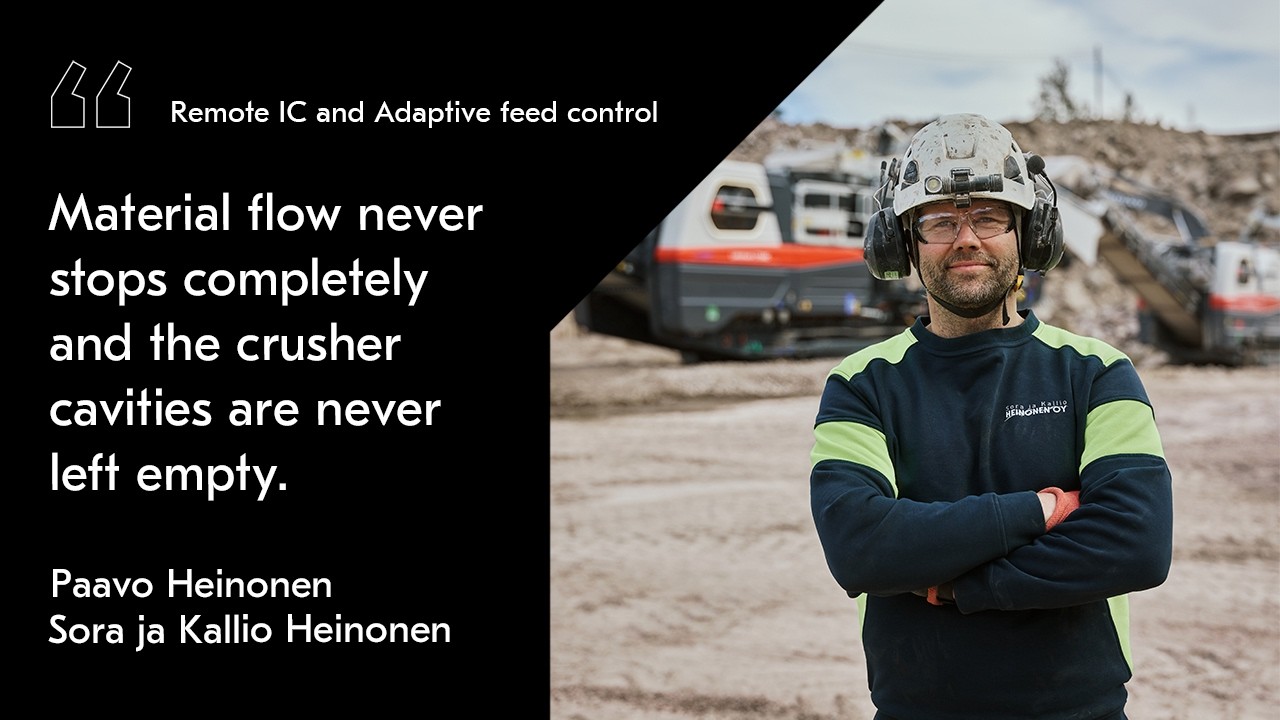
Paavo Heinonen at the pit, from Metso's video.
On September 9 Metso posted 90 seconds at Sora ja Kallio Heinonen in Finland, where the crushing and screening train runs on Remote IC with adaptive feed control. The system trims the feeder rather than leaving an operator to chase surges. Paavo Heinonen, who runs the pit, puts the result in the only terms that matter at the chamber: material flow never stops completely, and the crusher cavities are never left empty. That is the difference between a chamber that stays choke fed and one that swings between starved and packed, and choke feeding is what keeps liner wear even.